
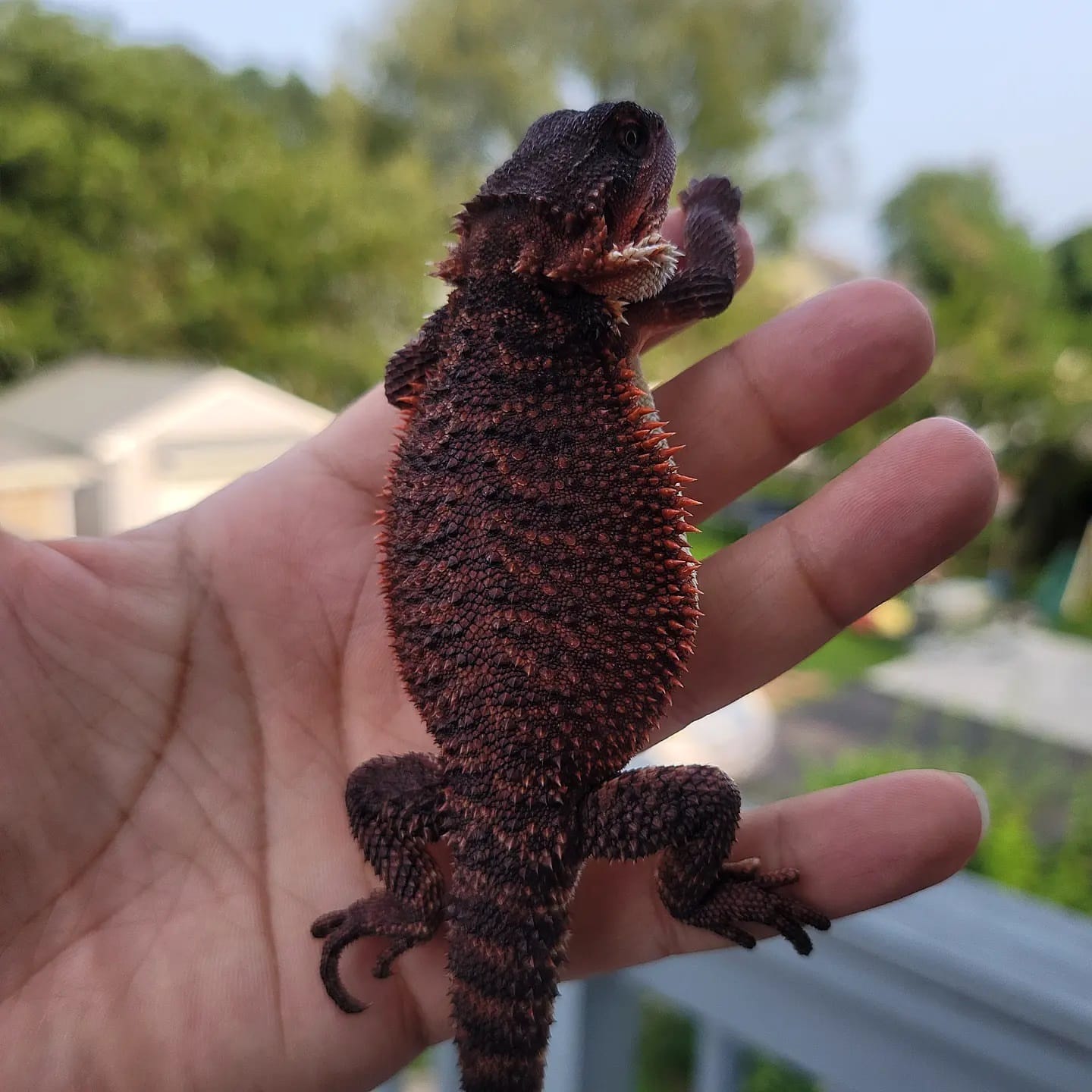
What Is a Red Bearded Dragon?
A red bearded dragon is one of the most visually striking forms of Pogona vitticeps, combining the familiar personality of a bearded dragon with rich red, burgundy, orange-red, and sometimes darker contrasting coloration. Years of selective breeding have produced captive lines with increasingly intense red pigmentation, making red dragons especially popular with keepers who want something more dramatic than the traditional tan and brown appearance.
Within that world, the red monster bearded dragon has become particularly well known for deep red coloration. It is useful, however, to understand the terminology correctly. “Red Monster” is generally used for a selectively line-bred red bloodline rather than a simple single-gene morph in the way terms such as Hypo or Translucent may be used. Selective breeding over generations is what intensifies the red phenotype.
Color is only one part of choosing a dragon. A healthy animal still depends on responsible breeding, correct UVB exposure, appropriate basking temperatures, balanced nutrition, hydration, and a properly designed enclosure. Current bearded dragon husbandry resources emphasize that lighting, heating, enclosure design, and nutrition work together; inadequate UVB or calcium balance can contribute to serious metabolic bone problems.
This guide explains what red dragons actually are, what makes Red Monster lines different, how coloration develops, what to look for when purchasing one, and how to provide appropriate long-term care. You’ll also find examples of red dragons currently represented within the Celestial Reptiles collection.
What Is a Red Bearded Dragon?
A red bearded dragon is generally a Central Bearded Dragon, Pogona vitticeps, that has been selectively bred for stronger red pigmentation than is normally seen in wild-type animals.
Wild-type bearded dragons tend to display earthier shades such as tan, brown, gray, yellow, and muted orange. Captive breeding has greatly expanded the available visual range, producing animals with vivid yellows, oranges, reds, white or gray patternless appearances, and numerous combinations of color, scale, and pattern traits.
Red coloration is therefore not necessarily one simple genetic mutation. In many red lines, breeders select animals displaying desirable pigmentation and pair them over multiple generations. Over time, that selective pressure can strengthen saturation, coverage, and consistency.
This is an important distinction for buyers. Two dragons both described as “red” may look dramatically different.
One may be bright orange-red with noticeable patterning. Another may show dark crimson coloration across much of the body. A third may combine red coloration with additional traits such as Hypomelanistic or Translucent.
For that reason, photographs of the actual animal are especially valuable when shopping for a red dragon.
What Is a Red Monster Bearded Dragon?
The red monster bearded dragon is associated with selectively bred bloodlines developed specifically for exceptionally strong red coloration.
Rather than viewing “Red Monster” as a single recessive gene that automatically produces one predictable appearance, it is more accurate to think of it as a line-bred phenotype or bloodline. Breeders repeatedly select animals that best represent the desired dark-red appearance and use them in subsequent generations.
This explains why quality can vary significantly between animals described using the same label.
A strong Red Monster example may show:
- rich red or crimson pigmentation,
- extensive red coverage,
- dark or dramatic contrast,
- strong coloration through the head and body,
- comparatively little dull brown coloration,
- coloration that remains visually impressive as the animal matures.
Genetic modifiers and other traits may also be present, but these should always be listed separately rather than assumed merely because an animal is described as Red Monster.
That distinction matters for both pet owners and breeders.
If you are buying primarily because you love the appearance, concentrate on the exact animal’s coloration and condition.
If you are purchasing for a breeding project, lineage, documented genetics, and breeder records become equally important.
Why Are Red Bearded Dragons So Popular?
The biggest reason is obvious: color.
A deeply colored red bearded dragon can look dramatically different from a standard animal while retaining the recognizable body shape, expressive behavior, and daytime activity that make bearded dragons such popular reptiles.
Bearded dragons are diurnal lizards, meaning owners can watch many of their normal behaviors during the day. They bask, explore, feed, climb, rest, and respond to activity around their enclosure.
They have also developed a reputation for being relatively manageable reptiles when appropriate care is provided. ReptiFiles currently classifies Pogona vitticeps care as moderate rather than effortless, which is a useful reminder that “popular beginner reptile” should never be interpreted as “low-maintenance pet.”
Red dragons appeal to several different types of keepers.
Some buyers simply want an unusually colorful companion.
Others collect different color lines and morph combinations.
Breeders may be interested in specific Red Monster bloodlines, Hypo combinations, Translucent combinations, or selectively bred high-red projects.
That broad appeal has made red dragons a major part of the modern bearded dragon market.
Red Bearded Dragon vs. Red Monster Bearded Dragon
These terms overlap, but they are not interchangeable.
Every red monster bearded dragon is being selected for red coloration, but not every red bearded dragon is necessarily from a Red Monster bloodline.
“Red bearded dragon” is a broad descriptive term.
It can include animals from numerous selectively bred red lines and combinations.
“Red Monster” is narrower and generally refers to a particular line-breeding approach associated with very intense red pigmentation.
This is one reason buyers should avoid choosing purely from labels.
When comparing animals, pay attention to:
Actual Color
Look at how much red is present across the head, back, sides, legs, and tail.
Contrast
Some dragons show darker accents that make their red base stand out more strongly.
Pattern
Red coloration may occur with bold patterning, reduced patterning, or other visual characteristics.
Other Genetic Traits
Hypo, Translucent, Leatherback, Zero, and other recognized traits are distinct from red line-breeding and should be identified separately when applicable.
Lineage
For breeding purposes, documented lineage matters much more than marketing terminology.
Overall Health
No color or bloodline is more important than obtaining an animal that is feeding properly, alert, appropriately conditioned, and responsibly cared for.
Examples of Red Bearded Dragons at Celestial Reptiles
One of the advantages of browsing individually photographed dragons is that you can compare different expressions of red coloration rather than relying on a generic morph photograph.
Black and Red Bearded Dragon for Sale
The Black And Red Bearded Dragon For Sale listing represents a Red Monster Bearded Dragon with bold red coloration and darker visual contrast. Celestial Reptiles lists the animal as captive bred and states that the exact dragon photographed is the one offered to the customer.
For shoppers attracted to dramatic contrast rather than uniform red alone, darker accents can create an especially striking appearance.
Suggested internal anchor: black and red bearded dragon
Dark Red Bearded Dragon for Sale
The Dark Red Bearded Dragon For Sale is another option for buyers focused on deeper red tones. The current product listing is positioned within Celestial Reptiles’ Bearded Dragon collection and is available as an individually listed animal.
A darker red animal can appeal to enthusiasts who prefer burgundy or deeper crimson coloration over brighter orange-red tones.
Suggested internal anchor: dark red bearded dragon for sale
Color Morph Bearded Dragons for Sale
For readers exploring a broader range of appearances, the Color Morph Bearded Dragons For Sale listing provides another route into selectively bred color varieties.
This is useful because shoppers sometimes begin their search wanting a red dragon but ultimately prefer a different pattern, shade, or morph combination once they see the available animals.
Suggested internal anchor: color morph bearded dragons for sale
Does a Red Bearded Dragon Require Special Care?
Generally, red coloration itself does not create a completely different husbandry system.
A red bearded dragon still needs the fundamentals appropriate for Pogona vitticeps: adequate enclosure space, a usable thermal gradient, strong UVB exposure, correct nutrition, supplementation, hydration, opportunities for movement, and routine health monitoring.
Certain unrelated morph traits can create special considerations, however. For example, scaleless Silkback dragons have documented husbandry and welfare concerns that differ from normally scaled animals.
That is why buyers should understand the complete genetics and physical traits of the animal rather than assuming everything about its care from the word “red.”
Red Bearded Dragon Enclosure Setup
A well-designed enclosure should give your dragon enough room to move between different temperature and light zones instead of experiencing one uniform environment.
ReptiFiles currently recommends a substantial enclosure for Pogona vitticeps, while veterinary guidance likewise emphasizes providing adequate space as dragons mature.
Your setup should include:
- a secure, appropriately sized enclosure,
- a strong basking area,
- a cooler retreat,
- high-quality UVB lighting,
- hides or sheltered resting areas,
- sturdy climbing and basking surfaces,
- easy access to food and water,
- safe substrate appropriate to your husbandry approach.
The enclosure should allow the dragon to make behavioral choices.
That means it should be able to warm up under the basking zone, move into a cooler area, climb onto different surfaces, retreat when desired, and explore.
A visually impressive animal deserves an enclosure designed around biology rather than decoration alone.
Heating and Basking
Bearded dragons are ectothermic reptiles. They rely on external heat to regulate body temperature and support digestion, activity, immune function, and normal behavior.
The basking region should be considerably warmer than the cool end of the enclosure, creating a usable gradient. Care recommendations differ somewhat depending on how temperatures are measured and the age or condition of the dragon, so owners should use current husbandry guidance and reliable measuring equipment rather than relying on a fixed thermostat setting alone. ReptiFiles provides regularly updated recommendations, and veterinary sources emphasize correct thermal provision as part of preventing metabolic disease.
Use a reliable digital thermometer and, ideally, an infrared temperature gun for checking basking surfaces.
Avoid guessing temperatures by touching the enclosure.
Human skin is not a reliable reptile thermometer.
UVB Lighting Is Essential
UVB should never be treated as an optional decorative light.
Appropriate UVB exposure is closely tied to vitamin D3 metabolism and the dragon’s ability to use calcium correctly. Poor UVB provision, inadequate thermal conditions, or nutritional imbalance can contribute to metabolic bone disease.
A suitable setup generally requires a quality linear UVB fixture positioned according to the bulb manufacturer’s recommendations, enclosure mesh, distance, and basking arrangement.
The basking zone should allow the dragon to receive both useful heat and appropriate UVB exposure simultaneously.
Replace UVB bulbs according to manufacturer guidance, even if the bulb still appears visibly bright. Visible light output does not tell you whether useful UVB output remains adequate.
What Should a Red Bearded Dragon Eat?
The diet of a red bearded dragon should be based on nutritional requirements, not on attempts to artificially increase coloration.
Bearded dragons consume both plant and animal foods. VCA notes that diet proportions change with age and that bearded dragons eat both plant material and insects.
Common foods can include suitable leafy greens and appropriately sized feeder insects.
Examples of greens often used in balanced diets include:
- collard greens,
- mustard greens,
- dandelion greens,
- turnip greens,
- other appropriate vegetables and greens.
Common feeder insects include:
- crickets,
- dubia roaches,
- black soldier fly larvae,
- silkworms,
- other appropriately sized, nutritionally suitable insects.
Calcium and vitamin supplementation should form part of a complete husbandry plan.
Do not assume that feeding brightly colored foods will permanently deepen a dragon’s genetically determined red pigmentation. Overall nutrition influences condition and appearance, but selective breeding remains the primary reason high-red animals look the way they do.
Does Diet Affect Red Coloration?
Nutrition can influence the overall condition of skin, scales, growth, and body condition, so a poorly nourished dragon may not look its best.
However, dramatic red pigmentation is largely associated with genetics and selective breeding rather than a special “red dragon diet.”
Color may also appear different depending on:
- lighting,
- temperature,
- shedding stage,
- stress,
- camera settings,
- surrounding colors,
- individual development.
This is another reason shoppers should evaluate several accurate photographs and avoid listings that rely heavily on extreme filters or artificial saturation.
When buying online, photos should help you understand the real animal rather than simply make it look spectacular.
Why Red Bearded Dragons Can Change Color
Many new owners become concerned when their dragon does not look exactly the same shade every hour of the day.
Some variation is normal.
Bearded dragons can appear lighter or darker depending on temperature, activity, stress, basking, shedding, and other conditions.
A dragon preparing to shed may develop duller-looking areas before the old skin is released.
A recently warmed animal may look different from one photographed under cooler conditions.
Juvenile coloration may also evolve as the animal grows.
Therefore, when choosing a red monster bearded dragon, look at the overall quality and consistency of pigmentation rather than expecting the animal to display one identical shade every moment of its life.
Temperament and Handling
Bearded dragons are often valued for their tolerance of routine human interaction, but each animal remains an individual.
A new dragon should be allowed time to settle into its environment before frequent handling begins. ReptiFiles recommends giving newly acquired dragons an adjustment period rather than immediately pushing extensive interaction.
When you begin handling:
- approach calmly,
- support the body properly,
- avoid grabbing from directly overhead,
- keep early sessions short,
- return the animal if it shows clear signs of stress,
- supervise interactions with children and other pets.
Handling should build familiarity rather than force compliance.
A relaxed dragon is usually much more enjoyable to interact with than one that is repeatedly stressed.
How to Choose a Healthy Red Bearded Dragon
Color attracts attention, but condition should determine the purchase.
Before purchasing, examine the available information and photographs carefully.
Look for an animal that appears:
- alert and responsive,
- appropriately conditioned,
- capable of moving normally,
- clear around the eyes and mouth,
- free of obvious injuries,
- supported by a clear feeding history,
- housed and described professionally.
Ask whether the dragon is captive bred and what it is currently eating.
VCA recommends that newly acquired bearded dragons receive an examination from a veterinarian experienced with reptiles shortly after purchase, including evaluation for general health and parasites.
This is a particularly good practice for buyers building long-term collections or introducing a new animal into a home where other reptiles are already present.
Captive-Bred vs. Wild Bearded Dragons
Virtually every responsibly sold pet bearded dragon should come from captive breeding rather than wild collection.
Captive breeding has produced the enormous variety of colors and traits now available in the hobby. It also provides buyers with more meaningful information about feeding history, husbandry, lineage, and genetics.
For a specialized animal such as a red monster bearded dragon, captive breeding is what makes selection for intense coloration possible in the first place.
Responsible breeders should accurately represent what they know about the animal and avoid making genetic claims that cannot be supported.
Are Red Monster Bearded Dragons Rare?
“Rare” is relative.
High-quality, intensely red Red Monster animals are less common than standard bearded dragons, but Red Monster lines are now established within the specialty reptile market. MorphMarket, for example, maintains active listings specifically categorized around Red Monster Bearded Dragons.
What matters more than the word “rare” is the actual quality of the animal.
A buyer should evaluate:
- saturation,
- coverage,
- pattern,
- other genetics,
- health,
- lineage,
- breeder reputation,
- overall value.
An expensive label does not automatically guarantee superior quality.
Red Monster, Hypo, Translucent and Other Traits
It is common to see red dragons combined with additional traits.
For example, Hypomelanistic dragons have reduced dark pigmentation, while Translucent animals have their own recognizable genetic characteristics. These are distinct traits from a selectively bred red bloodline.
A dragon can therefore potentially be described using several terms at once, such as a high-red animal with Hypo or Translucent genetics, provided those genetics are accurately documented.
This is why product descriptions should clearly separate:
Color line: Red, high-red, Red Monster.
Morph/genetic traits: Hypo, Translucent, Leatherback, Zero, and so forth.
Clear terminology helps customers understand exactly what they are buying.
Red Bearded Dragon Price: Why Does It Vary?
Prices for red dragons can vary substantially.
Factors may include:
- strength and saturation of red coloration,
- bloodline,
- documented genetics,
- additional morph traits,
- overall visual quality,
- breeder reputation,
- availability,
- individual condition.
A deeply saturated Red Monster from an established line will typically be positioned differently from a lightly red standard dragon.
Price should therefore be evaluated together with quality and documentation, not viewed in isolation.
Common Mistakes New Owners Should Avoid
Even experienced pet owners can underestimate reptile husbandry.
Some of the most common mistakes include:
Inadequate UVB
Using weak, incorrectly positioned, or expired UVB lighting can undermine otherwise good care.
Incorrect Temperatures
Without a proper thermal gradient, digestion and normal physiological functions can be affected.
Poor Diet Variety
Feeding only one vegetable or one feeder insect does not provide a thoughtful nutritional program.
Too Small an Enclosure
Bearded dragons require enough room for meaningful movement and thermoregulation.
Excessive Early Handling
New animals need time to adjust.
Ignoring Veterinary Care
Reptiles can hide illness surprisingly well. Establishing a relationship with an experienced exotic-animal veterinarian is worthwhile.
Good husbandry is not complicated because it uses lots of equipment. It is successful because every part of the system works together.
Internal Linking Strategy for This Article
Use internal links naturally rather than repeatedly linking the same keyword.
Recommended placements include:
- red bearded dragon → link to your Bearded Dragons category.
- black and red bearded dragon → Black And Red Bearded Dragon For Sale
- dark red bearded dragon for sale → Dark Red Bearded Dragon For Sale
- color morph bearded dragons for sale → Color Morph Bearded Dragons For Sale
- bearded dragon care guide → link to your educational care-guide page.
- bearded dragons for sale → link to the main Bearded Dragon category.
- shipping live reptiles → link to your Shipping & Delivery page.
- live arrival guarantee → link to your Live Arrival Guarantee page.
Do not use the same exact anchor ten times. Vary anchor text naturally so internal links help users navigate rather than appearing inserted purely for SEO.
Frequently Asked Questions About Red Bearded Dragons
What is a red bearded dragon?
A red bearded dragon is usually a Pogona vitticeps selectively bred for stronger red pigmentation. Red coloration can range from orange-red to dark crimson depending on lineage and individual expression.
What is a Red Monster Bearded Dragon?
A red monster bearded dragon generally refers to a selectively line-bred bloodline developed for intense red coloration. It is more accurate to think of Red Monster as a bloodline or phenotype than as one simple recessive morph gene.
Are Red Monster Bearded Dragons different from ordinary red dragons?
Yes. “Red bearded dragon” is a broad description covering many red-colored lines. Red Monster usually refers to lines selectively bred specifically for exceptionally strong red pigmentation.
Do red bearded dragons stay red?
Many retain strong red coloration, but shade and intensity can change with maturity, shedding, temperature, stress, lighting, and individual development.
Do red bearded dragons need different food?
No special diet is required simply because the dragon is red. Appropriate greens, vegetables, feeder insects, supplementation, hydration, UVB, and heating remain more important than feeding foods based on color.
Are red bearded dragons good pets?
They can be excellent reptiles for prepared owners. Their color does not fundamentally change the normal husbandry needs of Pogona vitticeps. Prospective owners should understand enclosure, UVB, heating, nutrition, and veterinary requirements before purchasing.
How can I tell if a Red Monster Bearded Dragon is high quality?
Evaluate actual coloration, red coverage, contrast, health, body condition, accurate genetics, lineage information where relevant, and photographs of the exact animal.
Where can I find a red bearded dragon for sale?
Celestial Reptiles currently lists individually photographed red dragons, including its Black And Red Bearded Dragon For Sale, Dark Red Bearded Dragon For Sale, and Color Morph Bearded Dragons For Sale pages.
Final Thoughts: Choosing the Right Red Bearded Dragon
A red bearded dragon offers something special: the familiar appeal of Pogona vitticeps paired with some of the most dramatic coloration available in captive-bred bearded dragons. From bright red animals to darker high-red lines, there is significant variation, which makes choosing the exact individual an important part of the buying process.
The red monster bearded dragon deserves particular attention because it represents the results of selective breeding for intense red pigmentation rather than simply a generic color label. Buyers should look beyond terminology and evaluate the actual animal, documented traits, health, feeding history, breeder transparency, and long-term husbandry requirements.
Most importantly, brilliant color cannot compensate for poor care. Strong UVB exposure, correct heating, a thoughtfully designed enclosure, balanced nutrition, supplementation, clean conditions, and appropriate veterinary support remain the foundation of a healthy dragon.
If you’re ready to add a red dragon to your collection, explore the current Celestial Reptiles listings and compare the exact animals available. The Black And Red Bearded Dragon For Sale, Dark Red Bearded Dragon For Sale, and Color Morph Bearded Dragons For Sale pages give you several different expressions of selectively bred coloration to consider.
For the blog itself, I would publish this under your Care Guides / Bearded Dragons content cluster and link it prominently back to the main Bearded Dragons for Sale category. That keeps the article primarily informational for the keyword “red bearded dragon” while still channeling commercial traffic toward your relevant products instead of making the blog post compete directly with your product pages.